When a Bookshelf Became a Fragrance
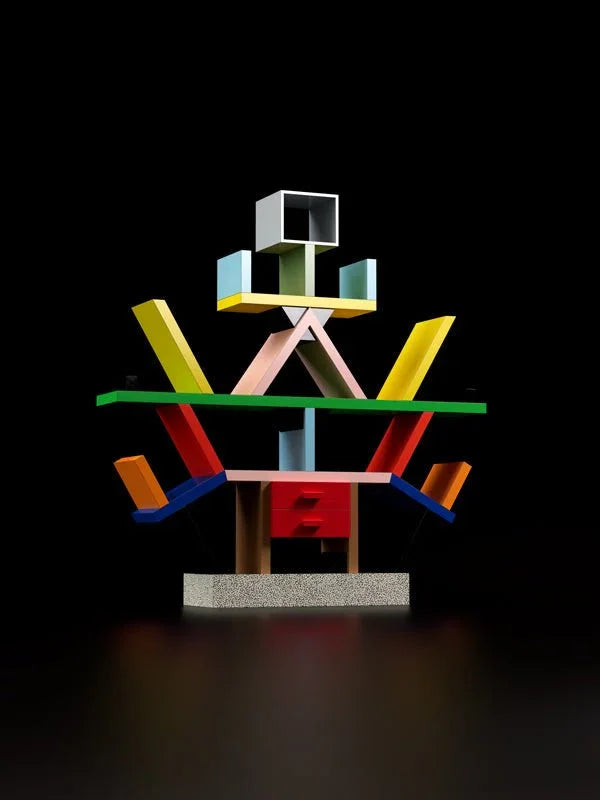
In 1981, Ettore Sottsass unveiled the Carlton bookshelf and the design world lost its mind. It was asymmetric. It was laminated in bright colors that had no business being on furniture - cheap plastic laminates over medium-density fiberboard, materials associated with kitchen countertops, not cultural objects. It looked like it had been designed by a child who had just discovered geometry and refused to apologize for it. The first collection landed at Milan's Arc '74 showroom on September 18, 1981, and the opening drew such a crowd - some 2,500 people - that when Sottsass arrived he mistook the commotion for a terrorist attack. These were Italy's Years of Lead. He had designed a bookshelf, and the street outside looked like a bomb scare. The critics called it absurd. Sottsass called it liberation.
We built our second fragrance - Rare Form - on that same liberation. Not as homage. As continuation.
To understand why a perfume house would ground a scent in the logic of a furniture designer, you have to understand what Sottsass was actually doing - and what he had survived to get there. Born in Innsbruck in 1917, he studied architecture at the Politecnico di Torino, endured a concentration camp in Yugoslavia during the Second World War, and spent two decades as a design consultant for Olivetti, where he helped shape everything from the Elea 9003 computer to the Valentine portable typewriter. The Valentine, designed in 1968 with Perry A. King, was bright red and deliberately impractical - Sottsass said it was invented "not for the office" but "to keep amateur poets company on quiet Sundays in the country." He chose red because it was, in his words, "the color of the Communist flag, the colour that makes a surgeon move faster and the color of passion." The man designed a typewriter the way other people write manifestos.
Memphis was born at night, in a room. On December 11, 1980, a group of young designers gathered at Sottsass's Milan apartment with Bob Dylan's "Stuck Inside of Mobile with the Memphis Blues Again" playing on repeat. This is the part of the story we keep returning to - not the showroom, not the crowds, but the apartment. Low light. Conversation that runs late because no one wants it to end. The hour when an idea is still private, still forming, still yours. The Memphis Group - named after the song that soundtracked that first meeting - included Martine Bedin, Aldo Cibic, Michele De Lucchi, Nathalie Du Pasquier, George J. Sowden, Marco Zanini, and Matteo Thun. Nine months later their first exhibition debuted fifty-five pieces of furniture, lighting, and ceramics, and every one of them looked like a provocation because every one of them was. But the provocation was public. The thinking was nocturnal. There is a difference, and that difference is the whole collection.
Memphis Design understood something that mainstream design still refuses to accept: that functionality without personality is just furniture. Sottsass and his collaborators rejected the beige minimalism of corporate modernism - the Bauhaus mantra of "form follows function," the cult of "good design" that had flattened European interiors into exercises in tasteful restraint - and built objects that vibrated with color, humor, and cultural tension. A lamp could be a sculpture. A table could be a provocation. The Carlton was both at once: a functional bookcase, yes, but also an anthropomorphic figure - deliberately designed to resemble a stick figure or an insect - whose slanted shelves were actually more practical than upright shelving, since books lean into the angle rather than toppling over. Even the absurdity was engineered.
Du Pasquier, who created the vast majority of Memphis surface designs, drew on African printed textiles, punk music, pop art, and art deco to produce patterns of loose geometrics and amoeba-like shapes in bright flat color. These were not decorative afterthoughts. The surfaces were the argument. Fragrance has the same opportunity right now. We just have to stop treating it like product and start treating it like material practice.
Here is the parallel that haunts us at MAISEUM. In 1981, the design world was dominated by a kind of tasteful rationalism that privileged function, neutrality, and the suppression of personality. A good deal of mainstream fragrance now runs on a similar consensus - clean, safe, optimized to offend no one and move units. Plenty of it is genuinely lovely.. we wear some of it. But the part of the market that sets the default has made a beige sofa the aspiration: pleasant, forgettable, designed to disappear.
Sottsass rejected that logic entirely. "I have always thought that design begins where rational processes end and magic begins," he once said. And elsewhere: "When I was young, all we ever heard about was functionalism, functionalism, functionalism. It's not enough. Design should also be sensual and exciting." He believed objects should influence "the nerves, the blood, the muscles, the eyes and the moods of people." That sensoriality was "the most primitive, the most immediate thing." That the way you truly interpret the world is mainly through your senses.
This is what perfumery does, or what it should do. The olfactory bulb sends signals to the amygdala and hippocampus without passing through the thalamic relay that filters every other sense. Smell reaches emotion and memory before it reaches cognition. It is, in that sense, the most Sottsassian of the senses: primitive, immediate, irreducible to rational analysis. When you smell something and feel it before you can name it, that is the limbic system doing exactly what Sottsass believed design should do. Bypassing the intellect. Reaching the nerves directly.
The Memphis revival happening now - the neo-Memphis movement in interiors, Memphis Milano's return to Salone del Mobile in 2025 with rare, never-produced Sottsass designs - runs on the same hunger that drives the niche fragrance boom. People are tired of disappearing. They want things that carry personality and the courage to be strange. Exuberance is not the opposite of intelligence. It is intelligence that has stopped being afraid of itself.
This is where the collection splits in two. Exhibition I is two fragrances, and they are one creative act in two registers. Savant Garde is the daytime - bright, awake, dopamine in a bottle, the September showroom with the crowds spilling into the street. Rare Form is the night before. The apartment. The evening conversation that becomes a movement. Read one against the other and the story is the contrast.
That is why Rare Form smells the way it does. It opens on vibrant citrus - the awake, the alive, the part of you that is most lucid at midnight when the idea finally lands. Underneath, aromatic spices - the warmth of a room where people are still talking, the Italian habit of taking your time. And below that, woody and earthy undertones - the deep, the grounded, the thinking that keeps going after the talking stops. Contemplative and vibrant at once. A scent does not have to choose between mysterious and awake any more than Sottsass had to choose between intellect and color. Rare Form lives in the space where those things are the same thing.
It does not reference Memphis literally. There is no "bright laminate" accord, no attempt to make a scent that smells like a bookshelf. What it references is the posture - the refusal to be tasteful when you could be alive, and the understanding that a material, whether plastic laminate or synthetic musk or brushed metal or hand-set type, is only as limited as the imagination of the person using it.
This is also why MAISEUM is not a fragrance brand. It is a design house that tells stories, and fragrance is the medium. The bottle holds the argument. The packaging extends it. The scent completes it. A bookshelf is never just a bookshelf - it is a room divider, a sculpture, a figure standing in your living room daring you to react. We believe a fragrance is never just a fragrance, and we believe a collection is never just a row of bottles. The two scents are in dialogue with each other, the way the apartment is in dialogue with the showroom.
Our perfumer, Marissa Zappas, helped us excavate something in these compositions - a poetic quality, a sophisticated mystery that lives in the space between what you can name and what you can only feel. Sottsass took the cheapest surfaces available and made them into cultural statements. We took molecules, metals, paper, and glass and tried to do the same thing.
What matters is not the object in itself. What matters is what it does on skin, in a room, in the space between two people. What matters is how it is lived. Memphis taught us that. We are still learning.
01Works in this story
From the registrar

Some works cited are held in other collections; MAISEUM may receive a commission when they find a home through us.